I restarted my homelab with Proxmox VE Helper-scripts and a phablet! - Part 3


Welcome back, it's literally been a minute since I published Part 2 of this series where I found a fix for the Pi-hole NTP sync errors.
I don't think there's going to be a separate need to discuss blogging on Ghost via mobile. It should suffice to say that copy-pasting images works better on Chrome mobile mode; you can get better native desktop-mode experience when using Firefox. The capability to flip back-and-forth seamlessly is a game changer for speed edits. I'm not sure about the experience using an actual tablet like the Google Pixel Tablet or a Chromebook like the Acer Chromebook Plus 14" (CB514-4HT-359X) but that's going to be one of the next experiments. My final edits have been on the old MacBook Pro, whenever it's still got a charge.
Part 3: Proxmox VE Helper scripts meets XDA Developers
Let me start with the elephant in the room, why use LXC instead of using the existing Docker VMs in my current stack? Well, let's talk about that.
I've been running MISP and OpenCTI for the longest time in a cluster for high-availability. Specifically, ElasticSearch can become unwieldy when you try to give it the best possible scenario when you've got limited rack space expansion and a power budget cap. Essentially, because of this I'm considering a re-do and clawing back resources these projects have taken over in resources. Plus, I've recently had some bad spells with old Portainer versions that over time has given me a bad taste in the mouth. And then, from the last time I had touched edits on Docker did Podman enter the picture. So far, in the past few months this might be the direction I take if only so I can learn more about it's pitfalls and the fact it is what you would get to use in a locked-down Red Hat enterprise image. There's alot to unpack there, but my point is that I don't take this decision lightly. There's going to be a learning curve and trade-offs to be made. I'll have to be OK with that. So, this is why we're going back to individual containers in the form of LXC instead of full VMs if we don't have to.
Now, with that out of the way, a brief note on XDA Developers. Hailing from the Philippines, I've been on the cutting edge of mobile computing since back in the Nokia days. If I couldn't get new stuff locally then I could always hop on a plane to Singapore and visit Sim Lim Square. And, on one of these trips is where I got hold of my first O2 XDA (and a bunch of Havaianas). Mind you, at around this time I was sporting the latest Nokia 9500 Communicator. I was ready for another form factor, let those parts sink in. Rooting and hacking bleeding edge mobile devices is how XDA and I crossed paths. Years later after transformation I really enjoy the self hosted section topics for my use case.
About Proxmox VE Helper scripts, I discovered this group while looking to experiment with lightweight versions of my homelab projects. What I would do was learn from the scripts and incorporate or improve on them for my specific use case. Now, however, I plan to use several of the templates to get things restarted based on availability and if something gets mentioned over at XDA.
I've already showed what a basic phablet install experience and experiment looks like over in Part 1 of this series. Here's where I've landed so far:
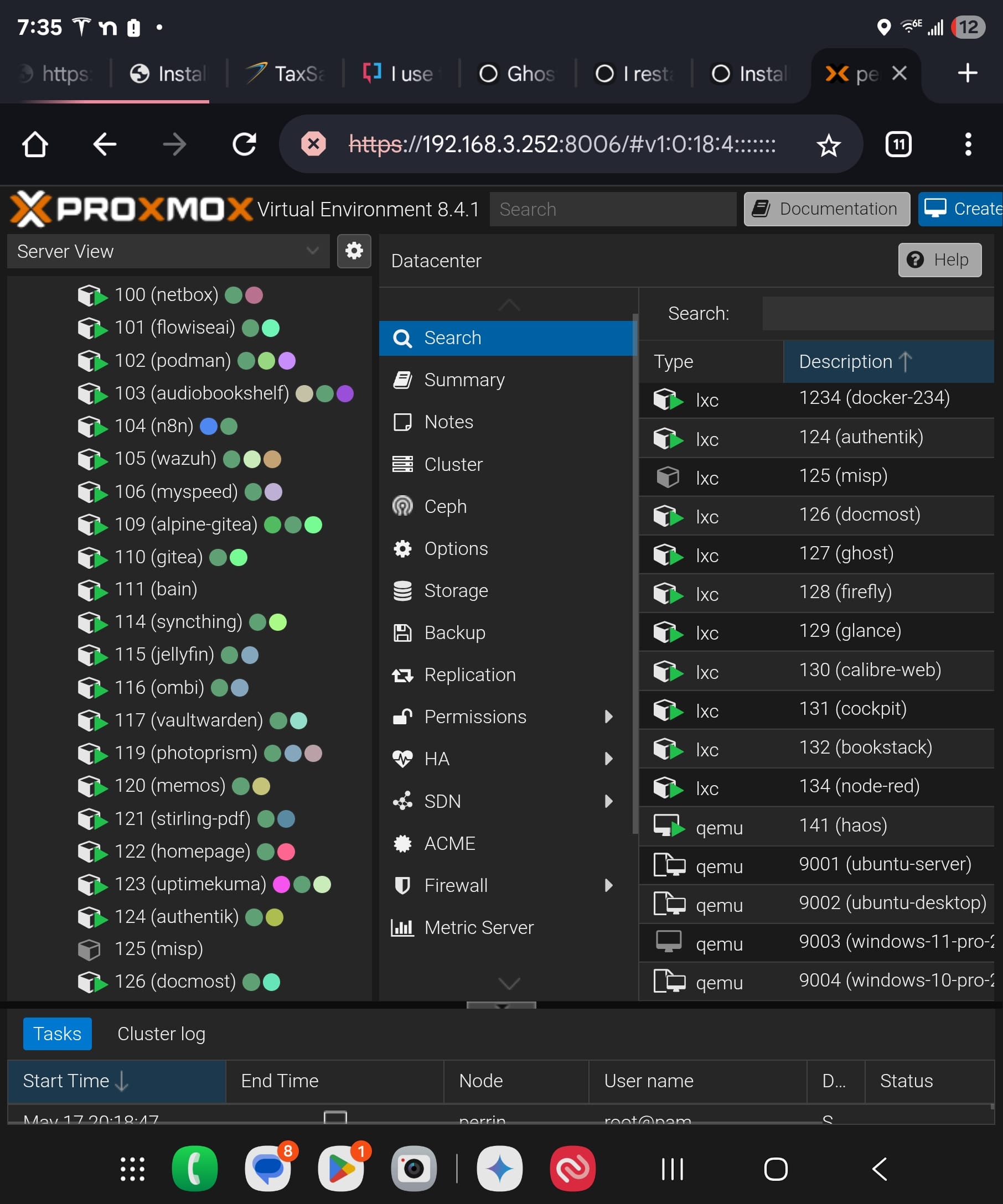
There's a big part of myself that cringes at the auto-numbering since my original schema was to map IP to VMID. If it matters that much later then, in theory, it should just be a matter of a backup and then restore to a specific VMID. Well, in my mind, that's how I'm coping with the situation.
In Part 4, we can discuss about the use cases and groupings of what's been installed. Or, I may just launch a new series based on specific group topic projects linked stemming from here.
Happy trails.